
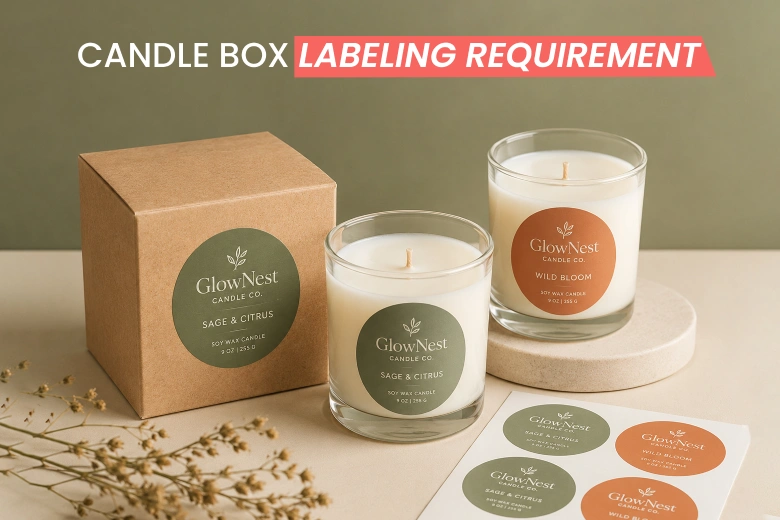
Candle Box Labeling Requirement: A Complete Guide for Candle Makers
- Candle Box Labeling Requirement: A Complete Guide for Candle Makers
- Three Legal And Standard Frameworks That Govern Candle Label Requirements
- Label Material And Durability
- Mandatory Candle Box Label Elements
- Optional But Recommended Elements of Label
- Label Placement And Design Guidelines
- Practical Placement Guide
- The Real Limitation: Space
- Common Candle Labeling Mistakes to Avoid
- Final Words
The labeling of some boxes is not only about aesthetics, and candle boxes are one of those. In candles, it plays a critical role in providing safety, legal compliance, and customer trust. When you correctly label your candles, you avoid possible legal issues, ensure the safety of your customers, and build trust in your brand.
In this blog, we will break down the candle labeling requirements in an easy-to-understand way, so you can follow them without hassle and stand out in the candle industry.
Three Legal And Standard Frameworks That Govern Candle Label Requirements
Before we explore the specific labelling requirements for candles, let us first understand the three foundations that regulate candle labelling.
FPLA (Fair Packaging and Labeling Act)
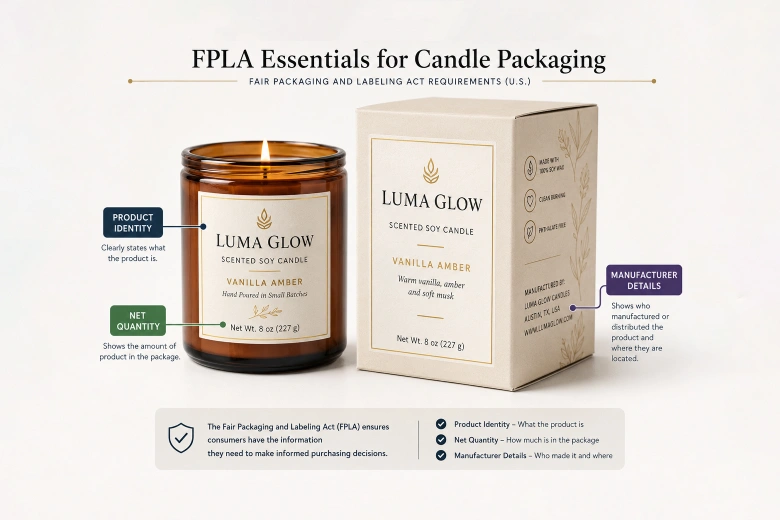
The FPLA is a baseline US legal standard that requires all consumer goods, including candles, to mention important information like product identity, net quantity, and details about manufacturers on their packaging.
ASTM F2058 Standard
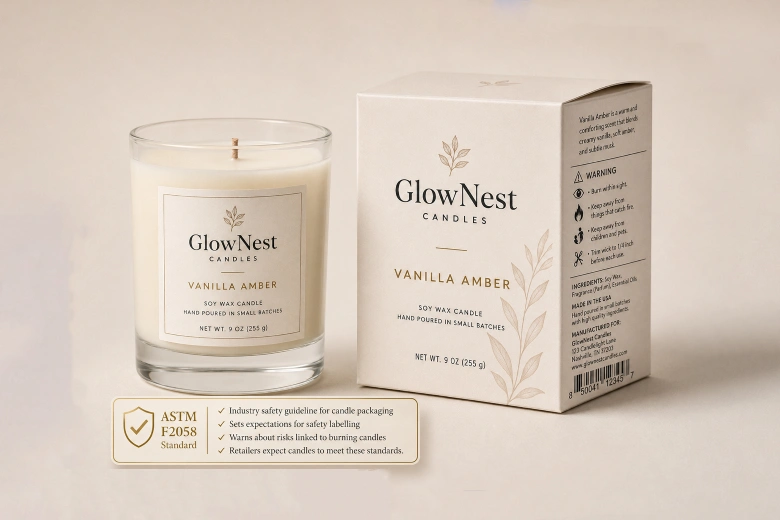
Many candle makers follow this industry safety guideline. It sets the expectations for safety labeling, which includes warning about the risks that are linked to burning candles. Retailers expect candles to meet these standards.
CPSC/FHSA (Consumer Product Safety Commission / Federal Hazardous Substances Act)
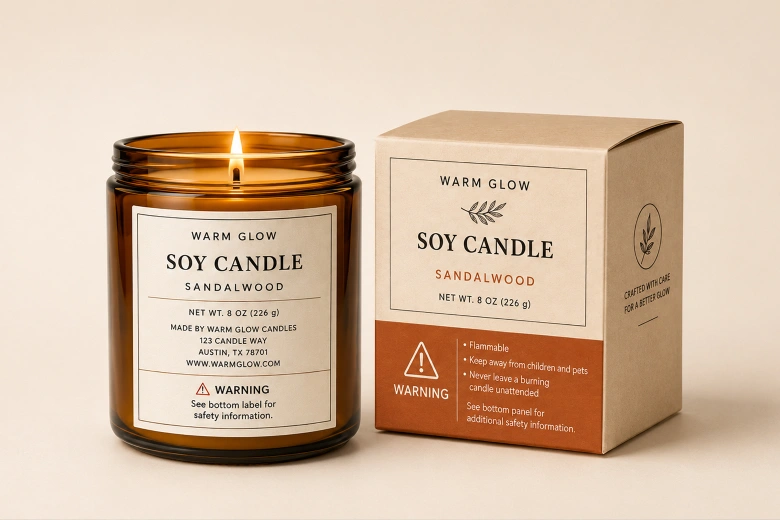
These rules require manufacturers to add warning labels when a product can be risky, like being flammable. For candles, this means adding warnings about fire risks and other safety concerns.
These standards set the foundation for what is legally required to add to your candle labels versus what is recommended to improve safety and trust.
Label Material And Durability
When choosing labels for your candles, the material is the key to providing the labels that last. We all know that burning candles produces heat, which can cause labels to peel, fade, or even fall off. To address this, many brands utilize custom candle labels made from durable materials that are resistant to water and spills, kraft for eco-friendliness, and BOPP (biaxially Oriented Polypropylene) labels that are more resistant to heat and maintain their integrity for a longer period. This makes it a more practical choice for candle packaging.
Even though durability is not a legal requirement. It is a practical necessity. A label that fades or peels off over time can result in non-compliance with the labelling standards, and it could also affect the safety of the product.
Mandatory Candle Box Label Elements
There are some essential elements that must appear on your candle packaging to meet with legal standards.
- Statement of identity: This is the name of the product. For example, “Lavender Soy Candle”). This helps customers instantly understand what they are purchasing.
- Net Weight: You must show the net weight of the candle in both U.S. customary units (oz) and metric units (grams). This is a requirement under the FPLA for all consumer goods.
- Manufacturer/Distributor Info: You need to mention the name of your business, address, and contact details. If your product is distributed by another company, include the phrase “Manufactured for” or “Distributed by.”
- Safety & Warning Information: This includes important safety warnings, such as “Burn within sight,” “Keep away from flammables,” and “Keep out of reach of children and pets.” These warnings can be in text or pictogram form, as required by ASTM F2058.
These elements are required to meet the basic legal standards for candle labeling.
Optional But Recommended Elements of Label
These elements are not always legally required, but can improve clarity, appeal, and help build trust with your customers. These include the candle scent or fragrance name, estimated burn time, wax type, key ingredients, and instructions on how to use the candle, such as trimming the wick. Also, including a batch or version number can help with quality control.
Another useful addition is a QR code linking to your brand’s story or providing safety data. This can be specifically valuable for online marketplaces like Amazon or Etsy.
Label Placement And Design Guidelines
Where and how you place your labels matters, not just for aesthetics but also for clarity and safety. Display your primary label that contains the names of your product on the front panel of the box or jar. This makes sure that it is the first thing your customer will see when they pick up your product.
Safety labels, which contain the warning and cautionary information, should be placed on the back or base of the packaging. As the front highlights the brand and product name, the back or bottom offers the most suitable place to mention these details.
For readability, use high-contrast text such as dark text on a light background. Keep the size of the font large enough to be legible, especially for safety warnings. The labels should follow a logical reading order, typically from top to bottom.
Specific to California, if your candle contains any substances that may cause cancer or reproductive harm, you must include a Prop 65 Warning. This should be placed at the bottom or back of the packaging, grouped with other safety-related information. The UPC barcode also usually goes at the bottom or back of the package for retail purposes.
Practical Placement Guide
| Label Element | Place | Why Does It Matter? |
| Primary Label | Front Pannel | First point of contact, brand visibility |
| Safety And Warning Information | Base or Back Panel | Safety message should be easy to access |
| UPC Barcode | Bottom or Back Panel | Necessary for retail sales and scanning |
| Prop 65 Warning | Bottom or Back Panel | Required for certain ingredients just in California |
| Manufacturer Info | Back Panel | Legal requirement for consumer transparency |
The Real Limitation: Space
When it comes to labeling candles, space on the container becomes a hurdle. Especially for smaller candle jars or boxes. Multiple label elements must fit onto a small surface area, which includes the product name, branding, and regulatory disclosures. This balance can lead to tight, overcrowded labels that may overload the packaging and damage its overall effectiveness.
Some common design issues originate from this challenge. For example, safety labels sometimes have to compete for space with barcodes on the base of the packaging, which can result in important information being too small to read clearly.
Moreover, required details, such as the manufacturer’s information or specific warning labels, might be pushed outside the Product Detail Page (PDP) when selling online. This makes them less accessible to potential buyers.
In some cases, labels may wrap too tightly around small jars, making it difficult for customers to read the important information without opening the product.
These issues occur due to the physical limitations of the container size. That is why many candle businesses rely on experienced manufacturer customcandleboxes.co to create candle packaging that balances branding, readability, and legal compliance without overcrowding the design.
This combination of legal requirements and consumer expectations often results in a tricky balance, where it is difficult to fit all the required elements without compromising readability or design.
Common Candle Labeling Mistakes to Avoid
When designing your candle labels, it is important to avoid several common mistakes:
- Small or faint warning text: Make sure safety warnings are clear and easy to read.
- Missing weight units: Include both U.S. customary (oz) and metric units (grams) for the net weight.
- No company information: Make certain your contact details are visible.
- Using unapproved symbols: Stick to approved symbols for safety warnings.
- Ignoring updated standards: Always stay up-to-date with any changes in labeling regulations to avoid non-compliance.
Final Words
Proper candle labeling is more than just a legal requirement. It is a way to show your customers that you care about their safety and transparency. By following the necessary legal frameworks, using durable material for labels, and considering the practical aspects of label design and placement, you make sure that your candles meet both safety and consumer expectations.
Take the time to review your labeling practices today and certify that you are not only compliant but also building trust with your customers.


Get Free Quote
Latest Posts
-
 October 15, 2026
Halloween Packaging Ideas for Candles: Spooky Style Meets Smart Branding -
 September 11, 2026
How Much Do Custom Candle Boxes Cost in 2027? -
 September 8, 2026
Cardboard Candle Boxes vs Kraft Candle Boxes: Complete Comparison -
 September 3, 2026
Rigid Candle Boxes vs Folding Cartons: Which Packaging Should You Choose? -
 September 1, 2026
Custom Candle Boxes vs Stock Candle Boxes: Which Is Better?